Saturday, May 30, 2009

Review of The Cellist of Sarajevo

Set during the Siege of Sarajevo in the early 1990s, The Cellist of Sarajevo follows three individuals over a period of about three weeks as they try to live their lives in the chaos that is war. Although it is a novel, the story used the factual story of a reknowned cellist who sat amongst the rubble of shelled buildings day after day playing at the site of a massacre of innocent people waiting to buy bread.

The story follows Arrow, Kenan, and Dragan, all strangers whose paths do not cross throughout the book. Arrow is a sniper who has been tasked with protecting the cellist from enemy fire. Kenan is a family man who is responsible for making the trek across the city to get water for his family. And Dragan is a baker whose family has left the city for safety in Italy. They all have their respective 'targets' as the story progresses: Arrow is targeting the sniper who has been sent by the enemy to assassinate the cellist; Kenan is targeting the brewery where he will be able to find fresh water; and Dragan is targeting the bakery where he hopes to buy some fresh bread.

I found this book to be quite contrived. I did not believe in any of the characters because Galloway never let us get to know them. Perhaps this was intentional -- how well can you know someone who is living through the insanity of war? -- but it resulted in the characters not feeling fully formed (which in several instances became confusing and I often found myself confusing Dragan's and Kenan's storylines). I also did not like Galloway's writing style -- every sentence seemed overly crafted, as though each word was intentionally placed after the next, making several parts of the book feel affected and, as I said earlier, contrived. Which is too bad, because I think the concept for the novel was unique and could have been the basis of a much better story had it been written somewhat more skillfully.

MY RATING: 4/10

Saturday, May 9, 2009

Review of The Ghost Road

The Ghost Road is the third and final book in Pat Barker's Regeneration Trilogy. It is set during the closing months of World War I, and centers around Dr. William Rivers, a psychologist treating mentally and physically injured patients from the front.

Unlike Regeneration where the story focused on Dr. Rivers as he treated patients, The Ghost Road picks up where The Eye in the Door left off. Billy Prior, one of Dr. River's more interesting patients is heading back to the front despite his asthma and potential for split personalities in highly stressful situations. Rivers continues to treat patients returning from the war with shell shock and psychological trauma back in England. However, the story also consists of several flashbacks to River's time as a missionary doctor in Melanesia.

As the final book in the trilogy (and winner of the Booker Prize), I had high hopes for The Ghost Road. Unfortunately, it didn't compare to the other two books. I found the flashbacks to River's time in Melanesia distracting from the arc of the storyline following the war and Prior's return to the front. This was the first time in the series when the reader is actually taken to the war itself as we follow Prior to France and experience the battles through him. Although the horrors of the war are terrifying to read about, it's as though, as a reader, the time has come to experience it alongside him -- having read two entire books describing the horrors through the psychological havoc it has inflicted on the men fighting, the reader is ready to "see" what could have created such damage. Although difficult to read about, the parts of the book that took place in France were the most riveting.

My guess is that Barker won the Booker prize for this third book as a nod to the trilogy itself (similar to Peter Jackson's Oscar win for 'The Return of the King', even though it was nowhere near the best film of the three). It's worth the read to bring Rivers' and Prior's stories to a close, just don't expect it to be the best one.

MY RATING: 6/10

Thursday, April 30, 2009

Review of The Eye In The Door

The Eye In The Door is the second book in the Regeneration Trilogy . Unlike the first book which centered mostly around Dr. Rivers, The Eye in the Door is split between Dr. Rivers' continued work with patients suffering from 'shell shock', and Billy Prior, one of Dr. Rivers' patients who was introduced in Regeneration.

The Eye in the Door takes place in the Spring of 1918, when the war was dragging on and defeat by Germany seemed possible. In England, politicians were distracting the public by targeting homosexuals, and the historical events of the time play a central role in the book. In fact, I've had a very difficult time writing this review because the story is so complex and nuanced with plot turns peppered by historical events, not to mention psychological food for thought. This is the type of book where each chapter could be a study of its own, either of history or psychology, yet there is a story that weaves its way through all of them and ties the book together.

Barker is an expert at conveying the emotions of a scene through dialogue. It's as though each chapter has it's own emotional theme (repression, fear, anger, sadness, love), and you feel it with the characters as you read. With the myriad emotions and politics surrounding homosexuality in England during this time set as the backdrop, Barker creates a tense but riveting story that is part history, part novel, part mystery, and part psychological study. Written by a lesser writer, this would probably have devolved into a chaotic and unsatisying read. But Barker manages to pull it off and I couldn't put it down. I didn't love it as much as Regeneration, but it doesn't fall far behind.

MY RATING: 9/10

Thursday, April 23, 2009

Review of Regeneration

Another fantastic read for 2009. I'm on a roll! After reading Birdsong last year for my book club, I became quite interested in WWI, and my father suggested that I read the series by Pat Barker.

Regeneration centers around Dr. William Rivers, a psychiatrist at the Craiglockhart War Hospital who is treating officers returning from the front. One of his patients is Siegried Sassoon, a noted poet of the day, who has be sent to Craiglockhart not because of war trauma, but because of an anti-war manifesto he wrote that was published in the newpaper. As Dr. Rivers works with Sassoon and many others, the scale of death and destruction, and seemingly endless stream of traumatized soldiers, starts to take its toll. Rivers is forced to confront his own demons and decide if and how he wants his career to proceed.

What makes this book so brilliant is how Barker is able to address so many themes in a 250 page book that consists of a lot of dialogue. These themes range from homosexuality (admitted and repressed) to supressed anger to the insanity of war. I loved her writing style as well - clear and to the point, but also full of imagery and feeling. No book review can do it justice.

The icing on the cake is that several of the characters in 'Regeneration' were real people, and Barker has based the story on actual events that occured at the time. This made the story that much more moving, and I am already into the next book in the trilogy.

MY RATING: 10/10

Tuesday, April 21, 2009

Review of Dreams From My Father

It's a great feeling to read a good book that is well-written, heartfelt, and educational. But it's an even more wonderful feeling when the smart, articulate, honest, and inspiring writer happens to be your President.

I've been meaning to read this book for a while, but it took picking it for our book club to actually get me to pick it up. I have to admit, there was something that felt oddly voyeuristic about reading such a personal memoir by Barack Obama. But it was also incredibly satisfying -- I loved learning about his childhood and his pathway to community organizing and law school. It was also nice to finally have the sequence of his moves to various states and countries explained, not to mention his family history.

I could tell that he wrote it at a time when he wasn't considering a political career, because he was honest about emotions, family relationships, struggles and weaknesses in a way that someone aspiring to become President of the United States would edit much more substantially. For that reason, it was a refreshing read. I loved that he shared his struggles and confusion with respect to his identity as a black boy growing up with a white mother and grandparents. It is not easy to write about race, but Obama wrote eloquently and honestly, and I learned a lot. My only criticism of the book is that, at times, I felt like some of the chapters dragged on a bit. Whereas the chapters from his childhood raced by, the sections on his time in Chicago and Kenya were not as riveting to me.

I could go into more detail discussing the complexity of Obama's father, his relationship with his other family members, and his time in Chicago, but I feel that you need to read the book instead, because it's worth it.

I will end the review by saying that reading this book reminded me again of what a fucking idiot George Bush is, and I question how we all actually managed to survive 8 years of his presidency. Thank God he's gone, and Hail to the Chief.

MY RATING: 8/10

Monday, April 13, 2009

Review of The Book Thief

This book was a gift from my friend Kristin. I visited her in Germany last September, and as we were walking throughout the picturesque streets of Frieberg I found myself struggling with the same sequence of thoughts I had struggled with during my previous (and first) trip to Germany in 1996. The sequence goes something like this: 1) As I am walking along I see an elderly person, somewhere in their 80s or 90s. 2) I think, "Damn, they're old! I wonder how old they are?" 3) Then I think, "If they're 85, that means they were in their 20s during WWII." And then I jump straight to 4) "I wonder if they were Nazis during the war...did they fight? Did they collaborate? Did they resist? What did they DO (or not do)?" And then I feel somewhat guilty for having those thoughts until I see the next elderly person and think them all over again...I can't seem to help myself. I shared this with Kristin at one point, and she told me to read "The Book Thief". "It will change the way you think about many of the Germans who lived through the war," she said. And then she bought it for me for Christmas.

The Book Thief is the story of Liesel, a skinny, hungry, and illiterate girl who is taken to live with the Hubermann's, a foster family in a small town close to Munich in 1939. The story follows Liesel through the war as she and her foster family resist the Nazis in the small ways that they can on the surface (such as Hans Hubermann refusing to join the Nazi party and paying the social price for it), and the big ways hidden below the surface (such as hiding a Jewish man in their basement).

I absolutely loved this book. In fact, it goes into my top 10. Part of the reason is because I haven't ever read anything like it. It is written in a unique style, but unlike other books that have dealt with serious subject matter by taking a unique approach to story telling which I hated because I felt they were so contrived (i.e. The History of Love or Extremely Loud and Incredibly Close), there is no posturing with the writing in the Book Thief, and instead I found myself wanting to dive deeper into the story with every page that I read.

I realized very quickly why Kristin had recommended this story to me -- it is a partial answer to the question I was asking when I walked the streets of Frieberg in September -- it is the story of what people who were not Jewish and not fighting DID during the war. And it is told without judgment, but instead through writing and imagery that is honest, touching, and beautiful to read.

MY RATING: 10/10

Saturday, March 14, 2009

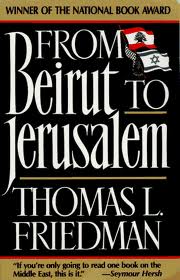
Review of From Beirut to Jerusalem

I saw this book on my friend Elie's night table when I was visiting her in San Francisco at the end of January, and was inspired to pick it up. I found a copy in the SF airport and got through the first 100 pages on my flight to Vancouver. It took me until last week to get through the remaining 470, not because the book wasn't good, but because I made sure to read it slowly enough to maximize my comprehension.

From Beirut to Jerusalem is Thomas Friedman's "take" on the Israeli-Palestinian conflict. He worked as a reporter in Beirut from 1979-1984 and then moved to Jerusalem, where he worked from 1984-1989. The book is written in two parts corresponding to these times and locations.

As someone who really did not know any of the history (except in broad brushstrokes), this book was a fantastic read. He describes the history, relationships, and personalities of all of the major players in the conflict, and for the first time I found myself understanding more than just the basics of this very complicated issue. It's a very well-written book, and the combination of historical facts peppered by his personal experiences and relationships because of his time living there kept it from being dull or too hard to understand.

For the most part, I don't agree with Thomas Friedman's views, especially on Iraq or the economy -- he always seems like too much of a Hawk to me. But his take on the conflict in the Middle East as he writes it in this book was something I found myself nodding my head to. Not only was he more 'dovish' than 'hawkish', but his sense of compassion really comes through.

There were several passages that resonated for me in this book, but I am going to end the review with the one that I liked the most:

"The Austrian-born philosopher Ludwig Wittgenstein once remarked that if you ask a man how much is 2 plus 2 and he tells you 5, that is a mistake. But if you ask a man how much is 2 plus 2 and he tells you 97, that is no longer a mistake. The man you are talking with is operating with a wholly different logic from your own."

MY RATING: 9/10